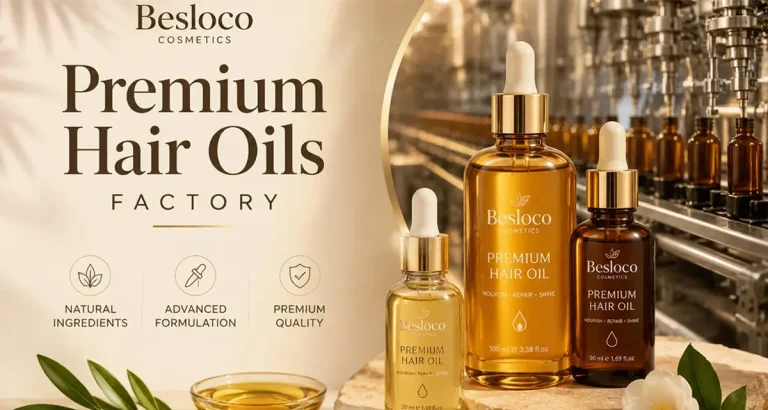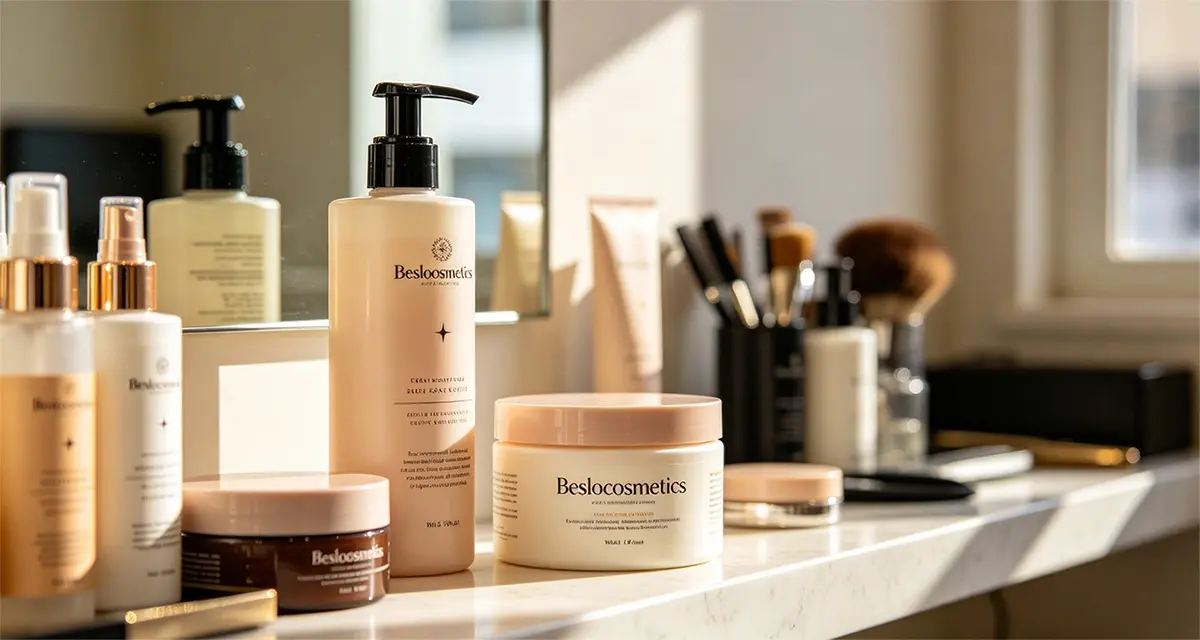
Let’s be honest. If you run a multi-location hair salon chain, your stylists are currently performing uncompensated diagnostics for Amazon.
During every consultation, your highly trained staff analyzes hair density, scalp health, and chemical history. They recommend a premium, third-party brand. The client listens, takes a photo of the bottle, and buys it on their phone before they even get to the parking lot.
You pay the overhead, the rent, and the training. Mass-market e-commerce platforms pocket 100% of the retail margin.
In 2026, the global salon hair care services market is a powerhouse, projected to reach USD 218.61 billion. Yet, individual physical salons operate on razor-thin net profit margins of 10% to 15%, with overhead and operations devouring roughly 70% of total revenue. Historically, high-margin retail sales—contributing up to 25% of overall turnover—served as your financial safety net. Today, that safety net is shredded by retail leakage and grey-market product diversion.
The only way to reclaim control of your business is to establish an absolute retail monopoly. You do this by launching a salon-exclusive, private-label hair care line.
The Hard Math: Third-Party Retail vs. Your Own Brand
To understand why transitioning to an in-house private-label line is the most profitable decision your chain can make, let’s look at the direct financial comparison.
We calculate the gross profit margin of a retail product using the standard industry formula:
Gross Margin = [(Retail Price – Landed Cost) / Retail Price] × 100%
When we apply this formula to the two business models, the difference is stark:
| Financial Metric | Third-Party Brands (e.g., L’Oreal, Redken) | Salon Private Label Hair Care |
|---|---|---|
| Average Gross Margin | 30%-50% | 50%-76% |
| Typical Markup Potential | 100%(Keystone pricing) | 200%-400% |
| Stylist Commission | 10% | 10%-15% |
| Diversion / Leakage Risk | High (E-commerce, drugstores) | None (Exclusively owned) |
1. The Financial Limits of Third-Party Retail
When you resell established brands, you are locked into the “Keystone” wholesale model. You buy a product for 10, retail it for 20, and enjoy a maximum gross margin of 50%.
If you pay your stylists a standard 10% retail commission to incentivize sales, your net take-home margin on that 20 product drops immediately to 40% .
On top of that, digital marketplaces are constantly undercutting your prices. unauthorized grey-market diverters frequently slash retail prices by up to 10 per unit, forcing you to price-match or lose the sale entirely. Your margins are consistently squeezed.
2. The Financial Freedom of Private Label
When you bypass the distributor markup and go direct to the manufacturer, you control the pricing.
Let’s break down the actual landed cost of a high-end, private-label hair repair treatment formulated at a premium level:
- Manufacturing & Formulation: $2.00 – $3.00
- Packaging & Labeling: $1.20
- Shipping & Logistics: $0.80
- In-Salon Marketing Assets: $0.30
- Total Landed Cost: $5.80
If you retail this specialty treatment at $24, you secure an immediate 76% gross profit margin ($18.20 profit per bottle).
Even after paying your stylists a highly motivating 15% commission ($3.60), your salon retains a highly protected 61% net margin ($14.60 profit per bottle).
Let’s break down the pathway of each dollar under both systems:
- The Traditional Third-Party Route: A retail price of $20 minus a wholesale cost of $10 and a stylist commission of $2 leaves the salon with a net profit of $8. This represents a 40% margin, which remains highly vulnerable to online price-matching and leakage.
- The Private Label Repair Brand Route: A retail price of $24 minus a landed cost of $5.80 and an increased stylist commission of $3.60 leaves the salon with a net profit of $14.60. This is a protected 61% net margin in a completely closed loop.
By transitioning a single hero product—like a daily repair hair oil or a leave-in molecular treatment—from a third-party brand to your own label, you instantly boost your per-unit profit:
- At 50 units per month, a private label product generates $650 in profit (compared to $500 with third-party).
- At 100 units per month, it generates $1,300 in profit.
- At 500 units per month, it scales to $6,500 in monthly profit.
As your chain grows and your order volume scales, you can negotiate lower minimum order quantities (MOQs) and bulk rates, driving your landed costs down and widening your margins even further.
The Parallel Economy: Why Your Retail is Leaking Online
The 2026 beauty market is deeply polarized. Industry data from CEW UK and NielsenIQ, highlighted in the “E-commerce Impact on Salon Retail.docx”, shows a highly competitive “K-shaped” beauty retail landscape. Consumers are either hunting for budget items or investing heavily in high-performance, premium, science-backed luxury.
Download the full market research: [E-commerce Impact on Salon Retail (DOCX)]
Physical salons are losing the digital battle to massive online platforms:
- Amazon is now the number-one online beauty merchant, with 60% of online beauty consumers making purchases there.
- TikTok Shop has rapidly expanded to secure the number-two spot.
- Generative AI search tools have decentralized discovery, with 49% of global consumers getting beauty recommendations from algorithms rather than physical experts.
- E-commerce has captured a massive 28.6% share of professional hair care distribution in the US, pulling sales away from traditional direct-to-salon pipelines.
This shift is fueled by product diversion—a grey-market parallel economy where salon-exclusive formulas are funneled to big-box drugstores, supermarkets, and unauthorized online sellers.
The Beauty Industry Fund (BIF) tracked this parallel market and estimated that diverted sales account for approximately 22% of the total professional hair care market, representing USD 1 billion to 5 billion in retail value.
Here is how the traditional grey-market leakage pathway works:
- Manufacturer to Distributor: The original product is shipped to official distributors.
- The Authorized Channel: Products are sent to physical salon chains for sale to the client.
- The Grey-Market Diversion Loophole: Cash-strapped salons or unauthorized middlemen purchase professional stock in bulk and divert it to mass retailers and online platforms like Amazon and TikTok Shop.
- The End Consumer: The client purchases what is often an expired, diluted, or counterfeit product, risking scalp damage while bypassing the physical salon entirely.
This grey market does more than steal your retail sales; it actively damages your brand. Diverted products bypass the authorized chain of custody, meaning they are frequently expired, diluted, tampered with, or outright counterfeit.
If a client buys a diverted, degraded bottle of “salon-exclusive” shampoo online and experiences scalp irritation or color fading, they don’t blame the online reseller. They blame your stylist’s capability and your salon’s reputation.
Formulating for Biological Resilience: What Customers Actually Pay For
To successfully launch an in-house repair brand, you cannot print your logo on generic, cheap formulations. High-end consumers are highly educated; they demand clinical, science-backed results.
As a formulation expert, I advise salon chains to focus their private label portfolios on categories defined in “Premium Professional Hair Repair Treatments, Cutting-Edge Technology, and Core Ingredients..docx”:
To review our advanced molecular active matrices, you can explore the [Whitepaper: Premium Professional Hair Repair Treatments & Core Ingredients].
1. Advanced Molecular Repair and Hard-Water Decalcification
We have moved past basic disulfide bond reconnection. Today’s premium standard focuses on molecular repair and mineral detoxification.
- Decalcification Systems: Calcium from hard water binds to hair keratin, making it stiff, rigid, and brittle. Formulate your private label backbar with a dual-action system using 3% Citric Acid (to actively dissolve calcium deposits) and 5% Glycine (an amino acid that penetrates the hair core to reconnect broken keratin chains).
- Biomimetic Peptides: Focus on bio-active peptides that mimic natural hair structures to rebuild the molecular framework of damaged fibers from the inside out.
2. Scalp “Skinification” and Follicle Longevity
Consumers now treat the scalp as an extension of the face.
- Microbiome and Derm-Grade Actives: Formulate scalp serums containing prebiotics, postbiotics, and bio-fermented actives alongside clinical superstars like Niacinamide, Salicylic Acid, Hyaluronic Acid, Caffeine, and Zinc PCA to prolong the hair follicle’s growth phase.
3. “Clean-Label” and Mandatory Compliance
Ingredient transparency is non-negotiable for modern consumers.
- Formaldehyde-Free Smoothing: Your smoothing systems must use safe, high-efficacy alternatives that rely on natural antioxidants (like resveratrol) and organic plant oils (argan and coconut) to seal the hair cuticle.
- Intelligent Sulfate-Free Cleansers: Avoid cheap sulfate substitutes that strip hair and lather poorly. Utilize mild, pH-balanced amino acid surfactants like Sodium Cocoyl Isethionate (SCI) blended with plant glucosides to deliver a rich, luxurious foam while maintaining a healthy pH of 4.8 to 5.5.
How Beslocosmetics Powers Your Private Label Supply Chain
Launching your own brand requires a manufacturing partner with world-class facilities and strict quality control. This is where we come in.
At Beslocosmetics, we operate three highly specialized manufacturing hubs to support your brand’s growth:
- Two state-of-the-art aerosol cosmetics factories located in Zhuhai, China, designed for precision manufacturing of hairsprays, dry shampoos, and treatment mousses.
- A third dedicated general cosmetics factory optimized for high-performance shampoos, conditioners, masks, and targeted clinical scalp serums.
We invest heavily in research and development, utilizing our advanced R&D spaces. You can see our focus on formulation precision in Our-advanced-cosmetics-laboratory.jpg and our specialized aerosol developments in Aerosol Hair Products Laboratory 1.jpg.


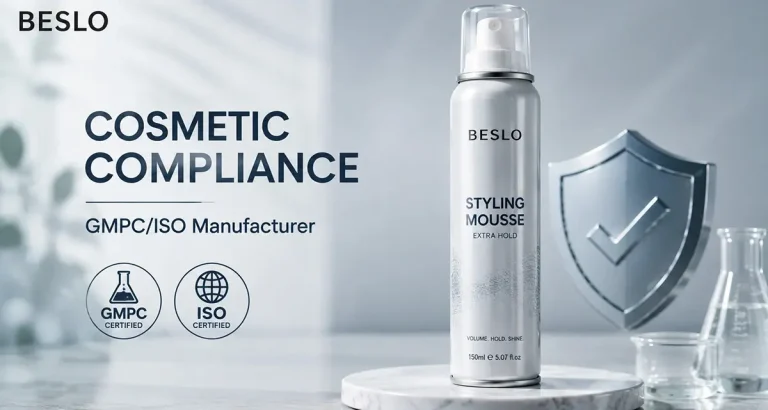
Every single formula we manufacture meets strict international standards. We handle the paperwork, certifications, and compliance so you can sell globally without legal friction. Our comprehensive certifications—including GMP, ISO, CPNP, Halal, and Cruelty-Free standards—are fully detailed in the document International quality management standards.jpg.

We actively track global beauty shifts and present our advanced formulations at major trade events. You can see our global presence and meet our team at international exhibitions, as documented in Beslocosmetics’s Cosmoprof Bologna.jpg.

The Churn Defense: Closing the Retail Loop
As documented in the “Case Studies on Enhancing Customer Retention and Repeat Visit Rates Through the Implementation of Private Label or Control-Brand Retail Strategies.docx”, multi-location salon chains lose an average of 30% of their client base annually to natural attrition. Establishing a proprietary, in-house brand is a highly effective defense mechanism to eliminate client churn.
To see real-world business outcomes, you can review our comprehensive [Case Studies on Enhancing Customer Retention Through Private Label Strategies (DOCX)].
1. Eradicate the Online Leakage Loophole
By launching an in-house private label, you establish an absolute monopoly. Your products are not on Amazon, Sephora, or discount drugstores. There is no competitor undercutting your price. If a client falls in love with your custom molecular repair mask, they must return to your physical salons or your proprietary e-commerce storefront to repurchase. You convert a one-time transactional retail sale into a recurring, predictable stream of repeat visits.
2. Extend the Treatment Room to the Vanity
Your branded homecare products act as a silent ambassador on the client’s bathroom vanity. Every time they use your custom-formulated post-color shampoo, they are reminded of the premium experience they received in your chair. This daily visual interaction keeps your brand top-of-mind, driving them to rebook before they drift to a competitor.
3. Power Subscription and Membership Models
With complete control over your product line, you can package services and retail into recurring subscription models. For example, you can bundle unlimited blowouts or monthly root touch-ups with a customized monthly subscription box of your private-label homecare. This stabilizes your cash flow and guarantees client commitment to your physical locations.
4. Drive Outcomes-Based Marketing
Modern digital tools make this transition seamless. Outbound marketing campaigns that focus on hair health outcomes and service preservation consistently outperform basic product promotions. Data from Phorest’s marketing campaigns shows that service-led, results-focused messaging achieves an average 47.42% open rate and a 9.40% click-to-book rate.
By pairing these targeted digital campaigns with online booking systems—which capture the one-third of clients booking outside of business hours—you can reduce your overall no-show rates by 49% and increase your salon’s annual revenue by up to 20%.
Our analysis reveals that salons starting a private label journey with customized, premium packaging report a 72% higher client retention rate compared to those reselling generic third-party products.
Real-world execution supports this:
- The Maya’s Luxe Hair Case Study: A professional stylist launched a specialized, private-label hair line. Within 12 months, the brand generated $237,000 in revenue with a remarkable 68% customer reorder rate.
- The Hanyinails Case Study: Top-performing salons integrating custom-branded private-label kits reported a 15% increase in annual revenue by linking product retail directly to in-salon service longevity.
The Strategic Path Forward
Physical salons can no longer rely on the passive display of third-party products on physical shelves. If you want to survive and scale in a highly competitive market, you must transition from a simple service provider to an elite, specialized hair authority.
By taking control of your supply chain and formulating a proprietary brand with Beslocosmetics, you protect your business from e-commerce giants, secure double the retail margin, and build an exclusive, closed-loop ecosystem that guarantees your clients keep coming back.
Are you ready to stop building other brands’ equity and start building your own? Contact Beslocosmetics today to collaborate with our formulation experts and start your private label journey.
Understanding the Salon Private Label Hair Care Supply Chain
About Salon Private Label Hair Care Supplier
About Custom Factory
OEM/ODM service
Private label service
Our Blog about hair care and styling products