Aerosol Leave-In Hair Mask Private Label: A Chemist’s Guide
My lab bench is currently a chaotic mix of pH test strips, viscosity meters, and different molecular weights of hydrolyzed keratin. The smell of synthetic squalane and compressed Dimethyl Ether is just permanently stuck to my lab coat at this point.
I’ve been formulating cosmetic chemistry for six years. I started my career working on heavy domestic skincare creams and even industrial pet deodorizers. Formulating a pet spray actually teaches you a lot about masking aggressive base odors without irritating sensitive skin—a rare skill that translated perfectly when I moved to the export division. For the past couple of years, I have spent almost all my time engineering export-grade hair and scalp treatments alongside our export manager, Karmen.
We get salon owners, brand founders, and regional distributors flying in from Colombia, Germany, and Vietnam. Karmen usually brings them directly into my R&D lab. They all sit across from my mixing vats with the exact same look of exhaustion.
Their salons are fully booked. Their stylists are working brutal ten-hour shifts on their feet. But their net profit margins are hovering at a depressing 8% to 15%. They are working harder than ever just to break even.
Let’s look at the actual physics of the market. The global hair care industry is not shrinking. It is exploding. Market data projects the industry will cross $122 billion in 2026 (you can verify the macro expansion in this Fortune Business Insights global industry report). The money is moving. Consumers are spending aggressively on their self-care routines.
So where is the salon’s cut? It is bleeding out through a structural crisis we call retail diversion.
The Physics of the Retail Bleed
To understand a salon owner’s anxiety, you have to look at their overhead. Labor and commission payouts are absolute black holes, usually eating up 45% to 55% of total gross revenue. Inflation has driven up professional chemical costs. A standard single-chair stylist operates under a physical time ceiling. You can only cut, color, or bleach a finite number of heads in a ten-hour shift.
The historical survival tactic was retail. Selling a bottle of premium shampoo carries a 40% to 50% profit margin and requires zero extra manual labor time. It was the ultimate profit amplifier.
That gold mine has collapsed.
Imagine a master stylist spending twenty minutes analyzing a client’s heavily bleached, damaged hair. They perform a complex color correction. They recommend a $40 premium hair mask from a massive global brand to maintain the bonds at home. The client smiles, pulls out their phone, snaps a photo of the bottle, and buys it online from a third-party seller for $28 while still sitting in the salon chair.
The stylist just acted as a free, highly trained offline diagnostic consultant for an e-commerce giant.
This is not an isolated incident. Current industry data reveals a staggering 95.6% of loyal salon clients now purchase their retail hair care products outside of the physical salon they visit (American Salon published a massive survey detailing this exact retail diversion crisis).
The root cause is retail arbitrage. Gray-market sellers liquidate unauthorized stock on giant digital marketplaces. Because of the “First Sale Doctrine,” once a brand sells a product, the buyer can legally resell it. Brand owners cannot effectively police millions of online listings. The salon owner is left trying to sell a $40 bottle against a $28 online listing with free next-day shipping. It is an unwinnable war.
You cannot fix this with “loyalty programs.” You cannot guilt-trip a consumer into paying a 30% premium. Consumers default to convenience and price.
The Private Label Monopoly
The only physical defense against retail arbitrage is absolute channel control. A Private Label brand.
When a stylist hands a client a product with the salon’s own logo, featuring a bespoke chemical formulation engineered specifically for their demographic, the price-checking loop dies instantly. The client scans the barcode. Nothing comes up on Amazon. Nothing comes up on Sephora. The gray market sellers do not have access to your proprietary inventory.
This absolute channel monopoly protects your 50% retail margin. But slapping your logo on a generic, cheap bulk shampoo will not work in 2026.
Modern consumers are ruthless. They read INCI ingredient lists on TikTok. They understand what peptides do. They demand the “Skinification of Hair”—treating the scalp and hair with the same high-end active ingredients used in facial serums. They also actively avoid harsh sulfates. They know that ingredients with a low critical micelle concentration (like SLS) strip the scalp’s lipid barrier and cause color fade.
This brings me to the actual chemistry, and the physical contradiction of modern hair care.
Consumers want intense, clinical-grade hair repair. But they are suffering from extreme time poverty. They refuse to wait.
I saw this firsthand when I traveled to a beauty trade show in Brazil with Karmen last year. Stepping out of the airport in São Paulo, the humidity hits you like a physical wall. Brazilian consumers heavily process their hair—bleach, keratin blowouts, aggressive color corrections. They have a deeply ingrained culture of maintaining scalp health.
But traditional wash-out hair masks in heavy plastic jars are fundamentally flawed for this environment.
Nobody has fifteen minutes to stand shivering in a shower waiting for a thick, heavy cream to absorb into the cortex. If you don’t rinse a traditional mask perfectly, the residual heavy oils suffocate the scalp follicles. In 90% tropical humidity, that residual oil leaves the roots aggressively greasy, flat, and unmanageable by noon.
Consumers want extreme structural repair with absolutely zero time investment.
The Rheological Engineering of the Aerosol Mask
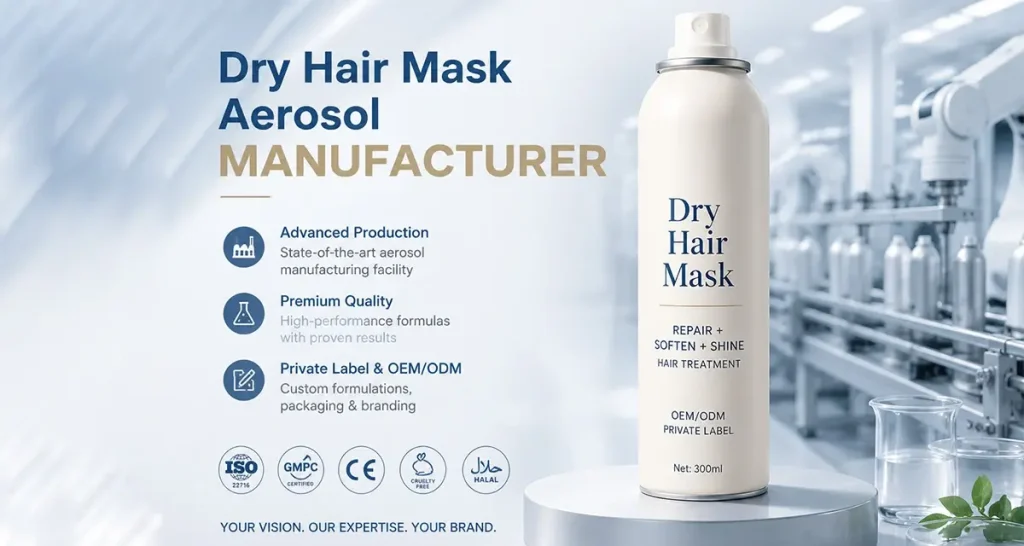
Karmen brought me a brief to solve this exact physical contradiction. The solution we engineered in the lab was a Leave-In Aerosol Dry Hair Mask.
This is where the engineering of non-Newtonian fluids gets fascinating. You cannot simply dump a thick, repairing hair cream into an aluminum aerosol can. It will choke the microscopic valve channels instantly. You will press the button and a solid block of white sludge will spit out.
We had to utilize a rheological principle called shear-thinning.
Inside the pressurized aluminum can, the formula maintains a highly stable, high-viscosity structural matrix. We achieve this by precisely balancing Stearamide Propyl Dimethylamine as the primary emulsifier with specific fatty alcohols. In this resting state, the active ingredients are suspended perfectly. They do not separate, settle at the bottom, or degrade over time.
When the user presses the actuator, the internal propellant forces the heavy liquid through a micro-valve. This extreme physical shear force instantly destroys the high-viscosity network. The liquid viscosity drops off a cliff in a fraction of a millisecond. The gas shreds the heavy repairing liquid into an ultra-fine, micro-mist aerosol.
It wraps around the damaged hair cuticles instantly. Zero heavy hands. Zero scooping mud out of a jar. Zero greasy residue.
We completely stripped out cheap industrial silicones. Silicones just coat the hair shaft in a suffocating plastic wrap, creating a fake slip that washes away. Instead, we engineered a micro-molecular matrix.
We utilized hydrolyzed keratin with a molecular weight strictly under 500 Daltons. It is physically small enough to ignore the closed cuticle barrier, penetrate deep into the cortex, and rebuild the broken protein chains from the inside out. We paired this with small-chain peptides to signal cellular repair, and botanical squalane to instantly seal the cuticle flat, locking the moisture inside.
We also strictly anchor the pH of the aerosol mist between 5.5 and 7.0. The human scalp acid mantle usually sits around 4.5 to 5.5. This precise pH anchoring means that if a consumer blindly sprays this aerosol mask and the mist lands directly on their scalp, it will not disrupt their micro-ecological barrier. No irritation, no flaking, no redness. Pure biological compatibility.
Cracking the ATV: The Economics of Service Layering
When you hand a product with this level of chemical engineering to a salon owner, it changes their financial math entirely. It solves the Average Ticket Value (ATV) bottleneck.
Single-chair salons are capped by the clock. A complex balayage takes three hours. You cannot magically make it take one hour. To increase revenue without increasing labor time, smart salons implement a strategy called Service Layering.
They integrate this proprietary aerosol mask into the actual salon service menu.
After a stylist finishes a harsh bleaching session, the hair is highly compromised. Instead of sending the client to the sink for a traditional 15-minute deep conditioning treatment (which eats up valuable chair time and requires a stylist to stand there rinsing), they grab their custom Private Label aerosol mask.
They spray the damp hair for exactly 30 seconds at the styling station. They proceed immediately to the blow-dry.
The client feels an instant, weightless silk texture. The salon charges a $35 to $50 “Micro-Molecular Shield” or “Flash Bond Repair” add-on fee to the final ticket.
Let’s do the math on that. That add-on required zero extra labor time. It required zero rinsing. The chemical cost of that 30-second spray of product is measured in pennies. It is pure, unfiltered profit margin. By integrating this fast-absorbing chemical technology, a stylist just increased their hourly earning yield by 30% without working a single extra minute.
You elevate the salon experience from a basic “haircut” to a clinical “hair healing” session.
The Physical Habit Loop and Forced Retention
If service layering solves the immediate cash flow problem, the retail aspect of this specific product solves the long-term survival problem: Customer Retention.
Industry metrics show that a healthy salon client returns every 7 to 8 weeks. That is a massive gap. In those two months, the client’s attention is constantly attacked by aggressive online marketing from competing brands.
The physical habit loop generated by an aerosol mask changes consumer behavior entirely.
Traditional jar hair masks are a “weekend chore.” The client uses it once every two weeks when they have time for a long shower. Because the aerosol mask takes under 30 seconds to apply and doesn’t require wet hands, it stops being a weekend treatment. It becomes a daily high-frequency habit, exactly like applying daily sunscreen or deodorant.
They spray it on damp hair before blow-drying. They spray it on dry hair to tame frizz before walking into the office.
Because they are using it daily, they drain the aerosol can in four weeks.
They run out of the product. They experience an immediate drop in hair quality. They search for the brand name online. They cannot find it on Amazon. The gray-market sellers do not have it.
The only place this specific, highly addictive chemical formulation exists is at your front desk.
The client has no choice. They physically return to your salon to buy another can. You have effectively broken the traditional eight-week salon visit cycle. When they walk in to buy the product at week four, the receptionist has a perfect touchpoint to book them for an early root touch-up or a glossing service.
You transformed a low-frequency client into a high-frequency brand advocate. The physical consumption rate of the aerosol gas dictates their return schedule.
The Maker’s Perspective
Formulation chemistry is essentially just problem-solving. We manipulate molecular weights, vapor pressures, and shear forces to fix broken hair bonds in a laboratory.
But a brilliant formula sitting in a beaker is useless if it doesn’t solve a commercial problem.
When you strip away the marketing fluff, the modern salon industry is fighting a brutal war against digital retail giants and rising overhead costs. You cannot win that war by selling the exact same commercial bottles that a teenager can buy online for cheaper.
You win by creating a physical monopoly. You win by engineering a product that is so fast, so effective, and so exclusive that it forces the consumer to depend on your physical location.
I need to get back to my bench. I have a new brief for an anti-humidity texture spray sitting next to my scale, and the stability ovens need to be checked. We just manipulate the molecules here in the factory. But when engineered with the end-user in mind, those exact same formulas have the power to completely fix the broken profit structures on a salon floor.
Contact Aerosol Leave-In Hair Mask Private Label Factory.
Leave-In Dry Hair Mask Supplier Information
Private-label aerosol hair care manufacturer
Dry Hair Mask Spray Product Page
About Custom Dry Hair Mask Factory
Dry Hair Mask OEM/ODM service
Private label Waterless Dry Hair Mask
Our Blog about hair care and styling products